A positively charged particle with charge \(q\) moves with velocity \(\mathbf{v}\) perpendicular to a uniform magnetic field \(\mathbf{B}\). If the magnitude of the velocity \(|\mathbf{v}|\) is doubled, what happens to the magnitude of the magnetic force \(\mathbf{F}\) acting on the particle?
What is the direction of the force acting on a negatively charged particle moving from East to West in a magnetic field directed downward (into the page)?
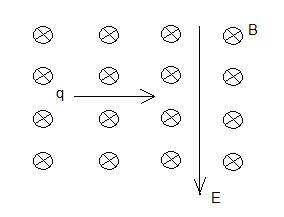
A negatively charged particle \(q\) enters from the left an area containing both an electric field directed downward and a magnetic field of magnitude \(6.0 \times 10^{-6} \, \text{T}\) directed into the page, as shown below. What must be the magnitude of the electric field so that the particle is not deflected if the magnitude of its velocity is \(2.0 \times 10^{5} \, \text{cm/s}\)?
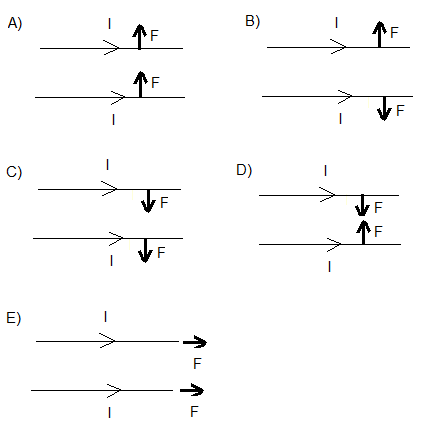
Which of the following diagrams represents the directions of the forces acting on two parallel wires carrying current \(I\) in the same direction?

If a force \(\mathbf{F}\) is exerted on a charged particle when it enters a magnetic field \(\mathbf{B}\) with velocity \(\mathbf{v}\), which of the following statements is always true?
If a magnetic field \(\mathbf{B}\) exerts a force \(\mathbf{F}\) on a wire of length \(L\) carrying current \(I\), what value of the angle \(\theta\) between the direction of the current and the magnetic field gives the maximum magnitude of \(F\)?
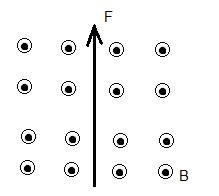
What is the direction of the current that experiences the force \(\mathbf{F}\) in the magnetic field \(\mathbf{B}\) shown in the diagram below?
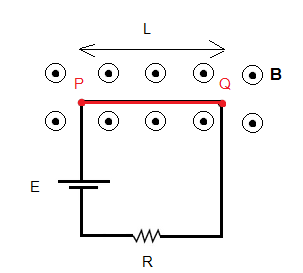
In the circuit below, wire PQ is part of a closed circuit and is in a magnetic field \(\mathbf{B}\). Neglecting wire resistance and battery internal resistance, which statements are true about the magnitude of the force acting on wire PQ?
- It is proportional to the magnitude of \(\mathbf{B}\)
- It is inversely proportional to \(R\)
- It is inversely proportional to \(E\)
Two parallel wires with equal currents \(I\) exert forces on each other with equal magnitudes. What happens to the magnitude of this force if the current in each wire is halved?
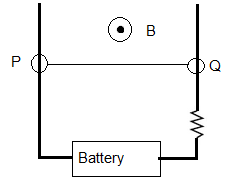
In the circuit below, wire PQ has a mass of 10 grams and length of 20 cm, and can move up and down with negligible friction. A uniform magnetic field \(\mathbf{B}\) of magnitude 1 T is directed out of the page. What must be the direction and minimum current in the circuit to lift wire PQ upward?