Displacement vs. Distance: Problems with Detailed Solutions
This page presents comprehensive solutions to problems involving displacement and distance—two fundamental but distinct concepts in kinematics. Distance is a scalar quantity representing the total path length traveled, while displacement is a vector quantity representing the change in position from start to finish, with both magnitude and direction.
Key Differences
- Distance $d$: Total path length (scalar, always positive)
- Displacement $\vec{\Delta x}$: Change in position (vector: magnitude + direction)
- Displacement magnitude: $\lvert \vec{\Delta x} \rvert = \sqrt{(x_f - x_i)^2 + (y_f - y_i)^2}$ in 2D
- Total distance ≥ Displacement magnitude (equality only for straight-line motion without direction change)
Problem 1: Linear Motion with Reversal
An object moves from point A to B to C, then back to B and finally to C along a straight line as shown.
a) Calculate the total distance traveled.
b) Determine the magnitude and direction of the displacement.
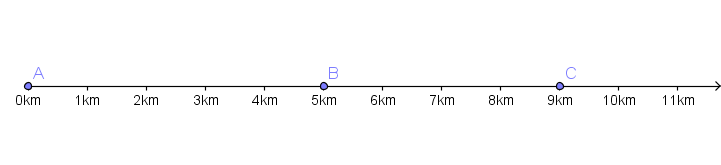
Solution to Problem 1:
a) Distance calculation:
The object travels: $AB + BC + CB + BC = 5 \text{ km} + 4 \text{ km} + 4 \text{ km} + 4 \text{ km} = 17 \text{ km}$
Total distance = $17$ km (scalar quantity, path-dependent).
b) Displacement calculation:
Initial position: A, Final position: C
Displacement magnitude = $AC = 9$ km (straight-line distance between start and end points).
Direction: From A toward C (eastward if A is left of C).
Problem 2: Rectangular Path
An object moves from point A to point C along the rectangular path shown below.
a) Find the total distance covered.
b) Calculate the displacement magnitude.
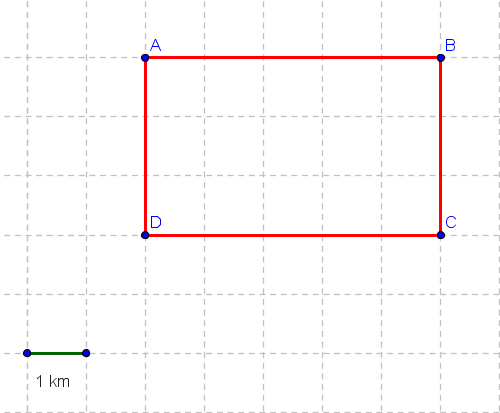
Solution to Problem 2:
a) Path distance:
$AB + BC = 5 \text{ km} + 3 \text{ km} = 8 \text{ km}$
b) Displacement (straight-line from A to C):
Using the Pythagorean theorem for right triangle ABC:
$$AC^2 = AB^2 + BC^2 = 5^2 + 3^2 = 25 + 9 = 34$$
$$AC = \sqrt{34} \approx 5.83 \text{ km}$$
Displacement magnitude = $\sqrt{34}$ km (approximately 5.83 km), directed from A to C at an angle $\theta = \tan^{-1}(3/5)$ from AB.
Problem 3: Complete Circular Motion
An object moves from point A to B to C to D and returns to A along a circular path.
a) Determine the distance traveled.
b) Find the displacement magnitude and direction.
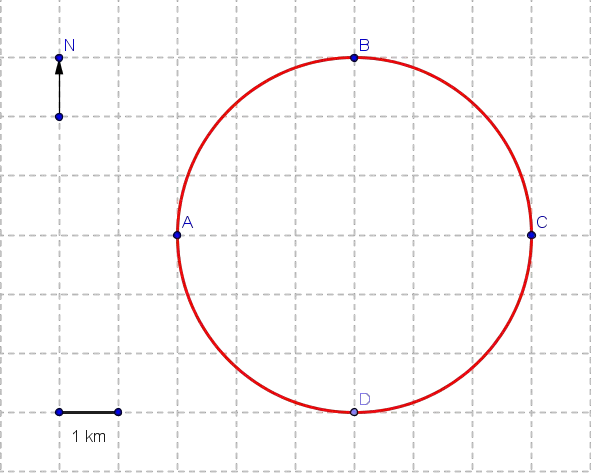
Solution to Problem 3:
a) Circumference distance:
The object completes one full revolution.
$$d = 2\pi r = 2\pi(3 \text{ km}) = 6\pi \text{ km} \approx 18.85 \text{ km}$$
b) Displacement for closed loop:
Initial and final positions are identical (both at A).
Displacement magnitude = $0$ km
Direction: Undefined (zero vector).
Problem 4: Partial Circular Path
An object moves from point A to B to C to D along a circular arc (three-quarters of a circle).
a) Calculate the distance traveled.
b) Determine the displacement magnitude.
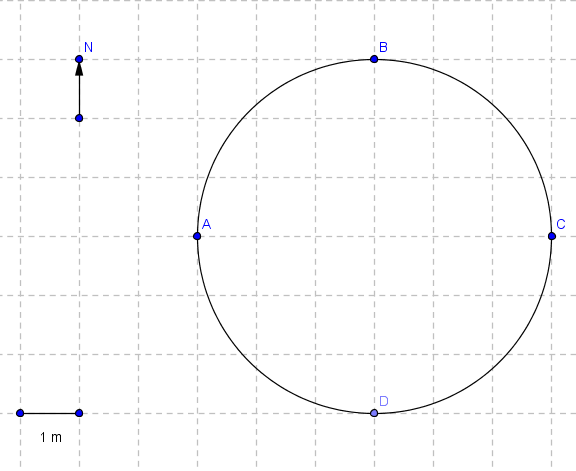
Solution to Problem 4:
a) Arc length (three-quarters circumference):
$$d = \frac{3}{4} \times 2\pi r = \frac{3}{4} \times 2\pi(3 \text{ m}) = \frac{9\pi}{2} \text{ m} \approx 14.14 \text{ m}$$
b) Displacement (chord AD):
Points A and D are connected by a straight line through the circle's center.
Using geometry: $AOD$ forms an isosceles right triangle with legs = radius = 3 m.
$$AD^2 = AO^2 + OD^2 = 3^2 + 3^2 = 18$$
$$AD = \sqrt{18} = 3\sqrt{2} \text{ m} \approx 4.24 \text{ m}$$
Displacement magnitude = $3\sqrt{2}$ m, directed from A to D (southwest if A is north of O).
Problem 5: Grid Navigation
An object moves along a grid through points A, B, C, D, E, and F.
a) Find the total distance covered.
b) Calculate the displacement magnitude.
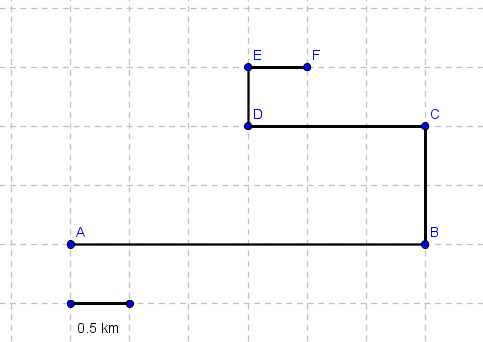
Solution to Problem 5:
a) Sum of path segments:
$AB + BC + CD + DE + EF = 3 + 1 + 1.5 + 0.5 + 0.5 = 6.5 \text{ km}$
b) Displacement from A to F:
The straight-line distance AF forms the hypotenuse of right triangle AHF.
Horizontal component: $AH = 4 \times 0.5 = 2 \text{ km}$
Vertical component: $HF = 3 \times 0.5 = 1.5 \text{ km}$
$$AF^2 = AH^2 + HF^2 = 2^2 + 1.5^2 = 4 + 2.25 = 6.25$$
$$AF = \sqrt{6.25} = 2.5 \text{ km}$$
Displacement magnitude = 2.5 km, directed from A to F.
Key Concepts Summary
Distance vs. Displacement
| Aspect |
Distance ($d$) |
Displacement ($\vec{\Delta x}$) |
| Definition |
Total path length traveled |
Straight-line change in position |
| Quantity Type |
Scalar (magnitude only) |
Vector (magnitude + direction) |
| Direction |
Not applicable |
From initial to final position |
| Possible Values |
Always positive or zero |
Vector |
| Path Dependence |
Depends on actual path taken |
Independent of path |
General displacement in 2D: \[ \vec{\Delta x} = (x_f - x_i)\hat{i} + (y_f - y_i)\hat{j} \]
Magnitude: \[ \lvert \vec{\Delta x} \rvert = \sqrt{(x_f - x_i)^2 + (y_f - y_i)^2} \]
Further Study and Practice